Registry
The Complete Baby Registry Checklist (What You Actually Need)
The 30-second answer
Register for about 25 things, not 150. Before week one you need somewhere safe to sleep, a car seat that fits your car, a way to feed the baby, roughly a dozen changing supplies, and a few clothing layers. Almost everything else can be bought later - after you know your actual baby - and about a dozen popular registry items are the ones parents most consistently say they never touched.
Every retailer’s baby registry checklist is a sales document. That’s not cynicism, it’s just what they are — the store makes money per line item, so the list runs to 150 things and includes a warmer for your wipes.
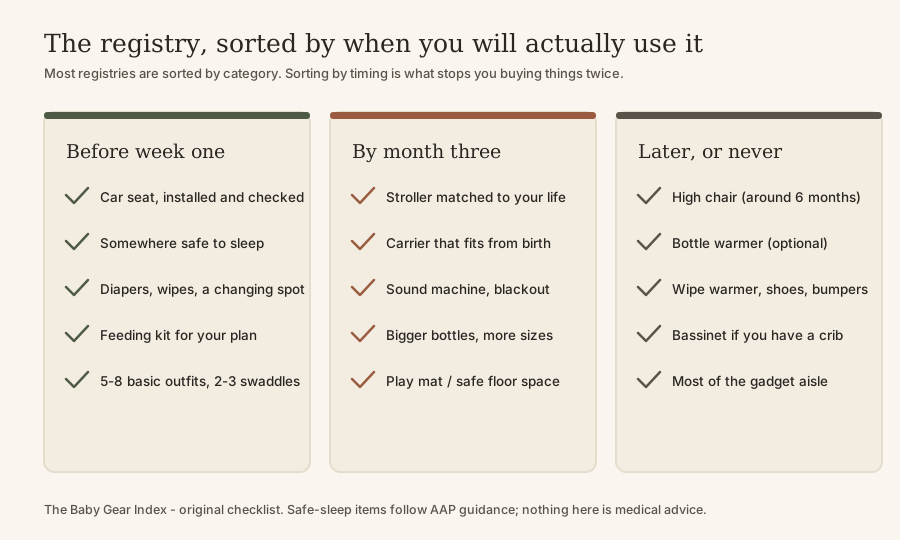
Here’s the same list rebuilt around a different question: when will you actually use this? Three groups — what you need before you come home from the hospital, what can wait until you know your baby, and what most parents say they never touched.
One piece of advice that outranks everything below: register for far more consumables than feels reasonable. Diapers, wipes, crib sheets, burp cloths. They’re unglamorous, guests will buy them, and they’re the things you’ll be ordering at midnight for the next two years.
Before week one
This is the genuinely short list. If a hospital discharged you tomorrow, this is what has to exist.
Somewhere safe to sleep. A bassinet or a crib with a firm, flat mattress and fitted sheets. Nothing else goes in it — no bumpers, no positioners, no loose bedding. Register for two or three fitted sheets and a couple of waterproof mattress protectors, because the sheet gets changed at 3 a.m. more often than you’d think. If you’re deciding between the two, bassinet or crib comes down mostly to your room size and the first six months.
A car seat that fits your car. Legally required to leave the hospital, and the one item on this list where the specifics really matter. An infant seat with a base is easiest in the newborn months; a convertible seat costs more up front and lasts years. Either way, get the installation checked — NHTSA runs free inspection stations, and correct installation matters more than which model you chose. Our car seat buying guide explains what the standards and ratings actually mean.
A way to feed the baby. If you’re planning to breastfeed, that may be nothing more than nursing bras, breast pads, and a nursing pillow — plus a pump if you’ll be pumping (check whether your insurance covers one before registering for it). If you’re formula feeding or mixed feeding, you need bottles, nipples, and a bottle brush. Register for one small set of bottles, not four. Babies develop preferences and you can’t predict them; buying five of the wrong bottle is a rite of passage.
Diapering, in bulk. Diapers in newborn and size 1 — but weighted toward size 1, because newborn size gets outgrown fast. Wipes by the case. A changing pad with a waterproof cover, plus two spare covers. Diaper cream. A dedicated diaper bin if smell bothers you, though a regular bin emptied often works.
Clothes, fewer than you think. Six to eight bodysuits, six to eight sleepers, a few pairs of socks, a hat, and swaddles or sleep sacks. Register mostly in 3-month and 6-month sizes — every guest buys newborn size, and your baby may skip it entirely.
Burp cloths and muslins. Ten. You will use all ten. They become burp cloths, changing mats, sun shades, and mop-ups.
By about month three
Things that become useful once the baby is a bit older, or once you know what they actually like.
A stroller — and this is the purchase where measuring pays off. “Compact” means nothing; folded dimensions mean everything. Measure your trunk before you register. Our stroller guides are organised by constraint: a small car trunk, travel and airplanes, tall parents, or twins. If you’re weighing a matched set against buying separately, travel system vs stroller and car seat is the fork.
A carrier or wrap. Register for one, not a collection. Fit is personal — what works for one body and one baby is uncomfortable for another. Many areas have babywearing libraries that let you try before committing.
A baby monitor, if your home layout needs one. In a small apartment you may genuinely not. In a larger or multi-floor house it’s one of the more useful purchases, and the specs matter more than reviews do because range depends entirely on your walls — large house and long range, or non-wifi if you’d rather nothing be on the internet.
Somewhere to sit. A glider or rocker is the nursery purchase people most consistently say they’d make again. In a small room, look specifically at the slim and armless versions — they’re genuinely different products, not just smaller.
A play mat or activity gym, a few soft books, and two or three simple toys. That’s the entire toy list for months. Newborns are not an audience.
A white noise machine, if your home is noisy or the nursery shares a wall.
Later, or never
Things worth deferring until you know they’d help — and the ones owner feedback most consistently describes as unused.
Genuinely defer: the high chair (not needed until solids, around six months — then see small spaces or convertible chairs), a full-size crib if you’re starting with a bassinet, the diaper bag if a backpack you own already works, and a video baby monitor if you haven’t decided you want one.
The commonly-unused list, drawn from patterns in owner feedback rather than any single opinion: wipe warmers · bottle sterilisers (a dishwasher or boiling water does it) · shoes for a baby who cannot walk · full bedding sets, which can’t be used in the crib anyway · specialised baby bath tubs, where a sink insert usually does · changing tables as dedicated furniture, when a changing pad on a dresser is more useful later · pacifier wipes · newborn-size clothing in quantity · toy sets sized for a much older baby.
None of it is harmful. It just tends to sit in a cupboard, and every one of those lines could have been more diapers.
The mistake worth avoiding
The expensive registry mistakes are almost never “I bought the wrong brand.” They’re “it didn’t fit.” A stroller that doesn’t fit the trunk, a crib that doesn’t fit the wall, a car seat that doesn’t fit three-across.
So before you finalise the registry, take five minutes and write down two numbers: your car’s trunk — length, width, and height at the narrowest point, with the parcel shelf where you normally keep it — and the nursery wall where the crib is going. Those two numbers will make more of your decisions than any review will.
If the nursery is small — and most are — our small nursery guide has the measuring template and the layouts that work under 100 square feet.
Buyer's checklist: how to choose
- Register for more of the boring consumables than feels reasonable - diapers, wipes, burp cloths, crib sheets. They get used every single day and nobody buys them for you later.
- Register across a wide price range. Guests self-select: some want a small gift, and a group will often go in together on the stroller.
- Register for two sizes up in clothing. Newborn clothes are outgrown in weeks and everyone buys newborn size.
- Delay anything that depends on the baby's preferences - carriers, pacifiers, bottles, sleep sacks. Register for one to try, not a set.
- Check the return window before the shower, not after. Most registries extend it; you will need it.
- Skip anything that only works for a narrow age band unless it's cheap or borrowed.
- Check current recall status on any big-ticket or secondhand item at cpsc.gov/Recalls before you use it.
Frequently asked questions
How many items should actually be on a baby registry?
Around 25 to 40 distinct items covers it, and a large share of those are consumables you'll list in multiples. Retailer-supplied checklists routinely run past 150 items because they're selling you things, not advising you. The useful test for each line: will this get used in the first three months, and would I buy it myself if nobody gifted it?
When should I create the registry?
Most people set one up somewhere in the second trimester, which gives time for a shower and for you to edit it as you learn more. There's no advantage to rushing - registries are editable, and the items you add later (after you've measured your car and your nursery) tend to be the better-chosen ones.
What do people most often regret registering for?
The consistent pattern in owner feedback is single-purpose gear that only suits a narrow age window or a baby with particular preferences: wipe warmers, bottle sterilisers, shoes for a baby who can't walk, full bedding sets (which can't be used in the crib anyway under safe-sleep guidance), and specialised bath tubs. None of it is dangerous - it just tends to sit unused.
Is it rude to register for expensive items?
No, and group-gifting is the reason. Most major registries let several guests contribute to one high-cost item like a stroller or a convertible car seat. What causes friction is a registry with only expensive items - keep a spread so guests can pick a level they're comfortable with.
Do I need bedding, bumpers, or a sleep positioner?
No. Under AAP safe-sleep guidance the crib should hold a firm, flat mattress and a fitted sheet - nothing else. Bumpers in particular are prohibited for sale in the US under the Safe Sleep for Babies Act. Register for extra fitted sheets and mattress protectors instead; those you'll genuinely burn through.
What about secondhand or hand-me-down gear?
Great for clothes, books, and most furniture. Be careful with car seats (they expire, and you can't know a used seat's crash history) and check anything structural against cpsc.gov/Recalls first. Drop-side cribs have been banned from sale since 2011 and shouldn't be used at all.
The staples, if you want to add them now
Unbranded basics where the brand genuinely does not matter much — the things this list says to get, without a guide attached because none is needed. Links go to Amazon search results so you can compare what is actually in stock.
- Fitted crib sheets — register for two or three - the 3 a.m. change is real
- Waterproof mattress protectors — two, for the same reason
- Muslin squares / burp cloths — ten. you will use all ten
- Newborn bodysuits — mostly 3- and 6-month sizes, not newborn
- Sleepers
- Diapers, size 1 — weighted toward size 1, not newborn
- Baby wipes, bulk
- Diaper cream
- Changing pad covers — plus two spares
- Bottle brush
- Nursing pads
- Nursing pillow
Sources, and when we checked
- CPSC recall database — recall history discussed in-page; confirm current status before buying
- NHTSA — car seats and booster seats — ratings, LATCH limits, installation
- American Academy of Pediatrics — HealthyChildren.org
We do not test products. Specifications come from the manufacturer's own published documentation; safety facts are cited to the primary source above rather than to secondary reporting.