Car Seats
Car Seat Buying Guide: FMVSS, NHTSA Ratings & JPMA Explained
The 30-second answer
Every car seat sold new in the US must meet the same federal crash standard, FMVSS 213 - it is a floor, not a ranking, so no compliant seat is 'safer' by federal certification than another. The real safety variables are choosing the right stage seat for your child's size, fit in your vehicle, and correct installation - NHTSA estimates nearly half of seats are misused, and runs free inspection stations. This page explains what every label, standard, star rating, and certification actually means, with one verified anchor pick per stage.
Car seat marketing is a fog of safety language, and almost none of it means what it seems to mean. This page is the reference we wish existed when we started mapping this category: what the federal standards actually require, what NHTSA’s stars actually rate, what a JPMA seal actually covers, and where the real safety decisions get made. Everything here traces to a primary source - NHTSA, the Federal Register, the CPSC, the AAP, or the manufacturer - and we note the check date because two of these standards are actively in motion.
Start with the one fact that reframes everything
Every car seat sold new in the United States must meet Federal Motor Vehicle Safety Standard 213 - the federal child restraint standard, whose core requirement is a dynamic sled test simulating a 30 mph frontal crash, plus labeling, buckle, webbing, and flammability requirements. Manufacturers certify compliance for every seat they sell. There is no federal grading on a curve: FMVSS 213 is a pass/fail floor, and every seat on the shelf passed.
So “meets or exceeds federal safety standards” on a box tells you the seat is legal to sell - nothing more. A budget seat is not less certified than a premium one. What actually varies between compliant seats, and what this site’s car seat guides compare, is fit: fit to your child’s size, fit to your vehicle’s back seat, and how easy the seat makes a correct installation. NHTSA’s own guidance says exactly this - the best car seat is the one that fits your child, fits your vehicle, and gets used correctly every time.
That last clause is the heart of it. NHTSA’s national misuse research estimates that 46 percent - nearly one in two - of car seats and boosters are used in ways that could reduce their effectiveness, with loose installation and loose harnesses the most common errors. The gap between car seats is small; the gap between a correct and incorrect install is not. NHTSA runs free inspection stations where certified child passenger safety technicians check your install - many now offer virtual checks - and using one is worth more than any upgrade in this catalog.
The four stages, and when to move
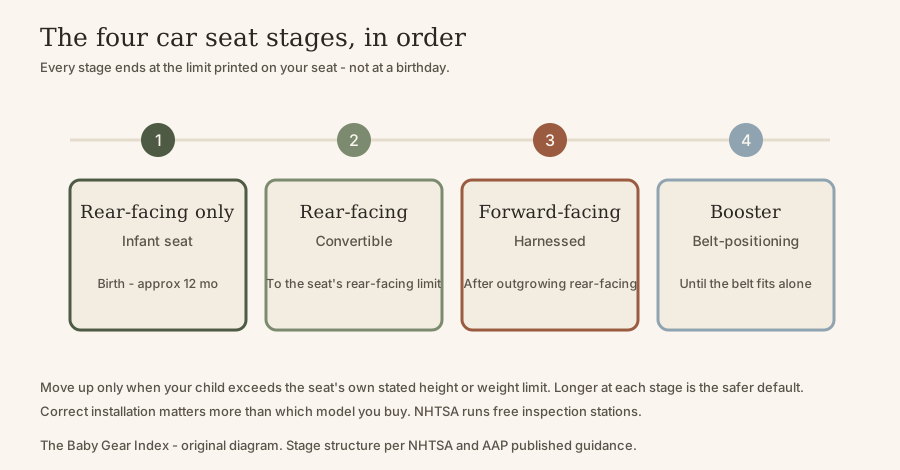
NHTSA’s framework runs in four stages, each hand-off triggered by the child outgrowing the current seat - not by birthdays:
Rear-facing (birth until the seat’s rear-facing limits). The American Academy of Pediatrics recommends children ride rear-facing as long as possible, until they reach the highest weight or height their seat’s manufacturer allows - and notes most convertible seats have limits that let children ride rear-facing for two years or more. Since 2018, the AAP guidance has been tied to seat limits rather than a fixed age. This is why the rear-facing height and weight maximums are the first columns in our convertible guide.
Forward-facing with a harness and tether (roughly ages 4-7, per NHTSA) - after the child outgrows rear-facing, until they outgrow the harness’s own height or weight limit.
Booster (roughly ages 8-12, per NHTSA) - the booster positions the vehicle’s own lap and shoulder belt across a small body correctly. It ends only when the adult belt fits without it: lap belt snug on the upper thighs, shoulder belt across shoulder and chest.
Seat belt - and NHTSA’s guidance keeps children in the back seat through at least age 12.
The common failure mode is graduating early - each move up trades some protection for convenience. The stages are a ratchet you should turn as late as the limits allow.
FMVSS 213a: the side-impact standard, accurately
You will see “side-impact tested” everywhere; here is what is actually happening, verified against the Federal Register at our check date.
In June 2022, NHTSA finalized FMVSS 213a, the first federal side-impact standard for child restraints. It applies to seats for children up to 40 lb (heights up to 43.3 in) and adds a second sled test: a simulation of a roughly 30 mph T-bone-style crash, using instrumented child test dummies. The original compliance date was June 30, 2025.
Then the date moved. In May 2025 NHTSA proposed delaying compliance to December 5, 2026 - citing test-lab capacity and the risk of seats leaving the market - and in July 2025 it published a formal notice that it will not take enforcement action on 213a until that proposal is finalized. As of this guide’s last update, no final rule had been published. The practical translation for a buyer:
- A seat without a 213a claim is not illegal or “failing” anything - the enforcement clock has not started.
- Some manufacturers already certify to 213a and say so explicitly on their pages; NHTSA has warned manufacturers not to claim it without actually certifying. Where a maker states it, we quote them.
- Before 213a, “side-impact tested” meant each brand’s own internal protocol - real testing, but to no common federal bar. That is exactly why the standard exists.
Separately, FMVSS 213b - an updated frontal standard that modernizes the test bench seats are crashed on - was finalized in December 2023 and becomes mandatory for seats manufactured on or after December 5, 2026.
NHTSA’s star ratings: what they rate, and what they do not
NHTSA publishes ease-of-use ratings for car seats, scored on stars. They evaluate exactly four things: the seat’s labels, its instructions, features for securing the child, and vehicle installation features. There is no crash-testing in the rating, and NHTSA states plainly that it is not a safety rating - every rated seat is already certified to the same crash standard.
Read the stars for what they are: an official, independent prediction of how likely you are to use the seat correctly - which, given the misuse numbers above, is genuinely valuable. NHTSA’s current ratings live inside its car seat finder tool at nhtsa.gov, and we point you there rather than quoting numbers, because the ratings are updated on NHTSA’s schedule, not ours. One thing you will never see on this site is our own star rating - the only stars worth your attention here are NHTSA’s, and they are always labeled as such.
JPMA certification - which is now the Baby Safety Alliance
The JPMA seal has been shorthand for “certified baby gear” for decades, so two 2025 changes are worth knowing. First, the Juvenile Products Manufacturers Association renamed itself the Baby Safety Alliance in June 2025, and its certification program continues as the Baby Safety Alliance Verification Program: voluntary, third-party, built on ASTM consensus standards, and covering thousands of products across dozens of categories. Second - and this reverses the old advice - the Alliance announced in August 2025 that its program now covers child restraint systems, a category it historically left entirely to federal regulation.
The hierarchy to keep straight: FMVSS 213 is the law - mandatory, federal, NHTSA-enforced, and the reason every new seat is crashworthy on paper. The JPMA/Baby Safety Alliance seal is voluntary verification layered on top. For products with no federal crash standard - high chairs, play yards, strollers - the seal does real work. For car seats, it is a supplementary check, not the safety line: a seat without it is neither less legal nor less crash-certified.
Recalls, registration, and the split between two agencies
Car seat recalls run through NHTSA, because car seats are motor vehicle equipment - the lookup is nhtsa.gov/recalls. The CPSC regulates most other nursery products, at cpsc.gov/Recalls, and the two agencies have issued joint recalls where an infant carrier’s out-of-car use was implicated. Checking both databases takes two minutes and is the habit we build into every guide on this site.
The recall system’s delivery mechanism is registration. Federal rules require every car seat to come with a prepaid registration card, require manufacturers to keep owner records, and require recall notice by first-class mail to registered owners. The 2026 Graco SnugRide Turn & Slide recall - a rotating infant seat whose carrier could detach from its base, remedied with free replacement seats - reached owners precisely this way. Register the seat the day it arrives, or in NHTSA’s SaferCar app, which pushes alerts for registered products.
Expiration dates and secondhand seats
Expiration dates are set by manufacturers, not by federal law. Typical spans run 6 to 10 years from manufacture - among our own picks, Graco states 7 years on its infant seat and 10 on its convertible, Clek states 9 - and manufacturers cite plastic and foam aging through heat cycles, evolving standards, and the end of replacement-part support. The date on your seat’s label is the operative one.
For used seats, NHTSA publishes a checklist, and it is strict on purpose. A secondhand seat is acceptable only if it has never been in a moderate or severe crash, has no recalls, is not expired, has all its parts, still carries its labels (you need the model number and date of manufacture to run the recall check), and comes with its manual. A marketplace seat that cannot prove its crash history fails the first line - which is why hand-me-downs from family you trust are one thing, and online used-seat listings another.
Where Consumer Reports fits
One organization does publish comparative crash testing of US car seats: Consumer Reports runs its own protocol beyond the federal test - frontal sled crashes at 35 mph rather than the federal 30, on a rig built to better resemble a real vehicle interior - alongside ease-of-use and fit-to-vehicle scoring. When our guides cite crash-performance differences between seats, that is who we cite, by name. We do no testing of our own, and we say so on every page: our work is reading the specifications, the standards, the recall databases, and the pattern of owner experience - and showing you the sources.
The comparison, at a glance
| Pick | Stage covered | Child size | Key install features | Expiration | Best for |
|---|---|---|---|---|---|
| Chicco KeyFit 35 | Infant (rear-facing carrier) | 4-35 lb / to 32 in | SuperCinch LATCH, dual levels, lock-off, anti-rebound bar | not published | Infant-stage anchor |
| Graco Extend2Fit Convertible Car Seat | Convertible (rear- then forward-facing) | RF 4-50 lb; FF 26.5-65 lb / to 49 in | Push-button LATCH, 6-position recline, level indicator | 10 years | Convertible-stage anchor |
| Chicco KidFit ClearTex Plus | Booster (belt-positioning) | 40-100 lb high-back; 40-110 lb backless; 44-57 in | LATCH attachment for stability; positions vehicle belt | not published | Booster-stage anchor |
The picks
Chicco KeyFit 35
Pros
- Install-aid stack per Chicco: SuperCinch LATCH tightener, dual RideRight bubble levels, leveling foot, steel-reinforced belt lock-off, anti-rebound bar
- 4-35 lb / 32 in limits per Chicco - a longer usable window than the 30 lb norm
- European belt routing for a more secure baseless install in taxis, per Chicco
Cons
- 10 lb carrier - heaviest among our infant picks
- Aircraft certification and expiration are stated in the manual, not on the product page
- Native stroller click-in is Chicco-only; other brands need adapters
Who it's for: The rear-facing carrier stage, from birth to roughly the first birthday. The KeyFit 35 anchors this stage because it stacks more correct-install hardware than anything near its price - and correct installation is this page's whole argument. Full comparison in our infant car seat guide.
Graco Extend2Fit Convertible Car Seat
Pros
- Rear-facing to 50 lb with a 4-position extension panel Graco states adds up to 5 in of legroom
- 19 lb seat weight and a 10-year expiration, per Graco
- Push-button LATCH, 6-position recline, 10-position no-rethread harness, per Graco
Cons
- 19.5 in wide per Graco - not a 3-across seat
- Bulky front-to-back reclined rear-facing in small cars, per owner reports
- No numeric rear-facing height limit published - the head-below-handle rule governs
Who it's for: The long middle stage: rear-facing from infancy to the seat's limits, then forward-facing with a harness. The Extend2Fit anchors it because its 50 lb rear-facing limit and leg-extension panel deliver the AAP's ride-rear-facing-as-long-as-possible guidance at a mainstream price. Full comparison in our convertible car seat guide.
Chicco KidFit ClearTex Plus
Pros
- High-back mode 40-100 lb and backless mode 40-110 lb, for children 44-57 in and age 4+, per Chicco
- High-back design positions both the lap and shoulder belt and adds head support for car naps
- LATCH attachment holds the empty booster in place, per Chicco - no loose-projectile booster when the child is not in it
Cons
- A booster relies entirely on the vehicle's own belt - the child must be mature enough to sit properly for the whole ride, per NHTSA's booster guidance
- Expiration is stated in the manual, not on the product page
- Belt fit varies by vehicle - check the shoulder-belt path in your actual back seat
Who it's for: The belt-positioning stage: a child who has outgrown the forward-facing harness (roughly ages 4-7, per NHTSA) but is not yet big enough for the vehicle belt alone. A booster's job is geometry - routing the adult lap and shoulder belt correctly across a small body - and the KidFit ClearTex Plus is the mainstream high-back benchmark.
Buyer's checklist: how to choose
- Pick the stage by the child's size, not age: rear-facing to the seat's height/weight limits (per AAP), forward-facing harness to its limits, booster until the adult belt fits - lap belt on the upper thighs, shoulder belt across chest and shoulder (per NHTSA). Back seat through at least age 12.
- Buy for your car as much as your child: a seat that fits your back seat and that you can install correctly beats any spec sheet. NHTSA's stated guidance is to choose a seat that fits your child and vehicle and is installed correctly every time.
- Install with lower anchors or the seat belt - never both, per NHTSA - and always attach the top tether forward-facing. Lower-anchor limit rule of thumb, per NHTSA: 65 lb minus the seat's weight, then switch to the belt.
- Get the install checked: NHTSA-listed inspection stations offer free checks by certified child passenger safety technicians, and many now offer virtual checks.
- Register the seat and check recalls at both nhtsa.gov/recalls and cpsc.gov/Recalls - registration is how recall notices reach you, and manufacturers are federally required to provide the card.
- Check the expiration label before buying, and apply NHTSA's secondhand checklist before accepting any used seat: no crash history, no recalls, all parts, labels intact, manual included.
Frequently asked questions
Are NHTSA's star ratings safety ratings?
No - and NHTSA itself says so. The ease-of-use ratings score four things: labels, instructions, securing the child, and vehicle installation features. There is no crash-test component, and NHTSA states the rating is not a safety rating. Every rated seat is already certified to the same federal crash standard. The stars are genuinely useful for predicting how hard a seat is to use correctly - which does affect real-world safety - but a 3-star seat did not crash-test worse than a 5-star seat.
Is a car seat without JPMA certification less safe?
No. Car seats are federally regulated by NHTSA under FMVSS 213 - that is the mandatory bar, and every new seat must meet it. The JPMA seal (now the Baby Safety Alliance Verification Program - the organization renamed itself in June 2025) is a voluntary third-party program built on ASTM standards, and for decades it did not cover car seats at all; the Alliance announced car seats (child restraint systems) as a new verification category in August 2025. Treat the seal as optional extra verification, mainly meaningful for non-regulated nursery gear - never as the dividing line between safe and unsafe car seats.
What is the status of FMVSS 213a, the side-impact standard?
In motion, so here is the verified sequence: NHTSA finalized FMVSS 213a in June 2022 for seats used by children up to 40 lb, with compliance originally due June 30, 2025. In May 2025 NHTSA proposed delaying compliance to December 5, 2026, and in July 2025 it formally announced it will not enforce 213a until that rulemaking is finalized. As of this guide's last update, no final rule had been published - so some seats on shelves are certified to 213a (manufacturers who say so state it explicitly) and others are not yet, and NHTSA has warned manufacturers not to claim 213a compliance without actually certifying to it. The frontal-standard update, FMVSS 213b, becomes mandatory for seats manufactured on or after December 5, 2026.
Where do I check for car seat recalls?
Two places, because jurisdiction splits: NHTSA handles car seat recalls (car seats are motor vehicle equipment) at nhtsa.gov/recalls, and the CPSC covers other nursery products at cpsc.gov/Recalls - the agencies have also issued joint recalls when an infant carrier's out-of-car use is involved, so checking both is the thorough habit. NHTSA's SaferCar app pushes recall alerts for products you register in it. And send in the seat's registration card: manufacturers are federally required to provide one, and mailed notices to registered owners are how recalls actually reach people - Graco's 2026 SnugRide Turn & Slide recall being the recent example.
When should my child move from a harness to a booster?
When they outgrow the forward-facing harness by height or weight - typically somewhere in ages 4-7, per NHTSA - and are mature enough to sit properly the whole ride. NHTSA's booster guidance then runs to roughly ages 8-12: the booster's job ends only when the adult belt fits on its own, meaning the lap belt lies snug on the upper thighs (not the stomach) and the shoulder belt crosses the shoulder and chest (not the neck or face). Moving up a stage early is the common form of misuse - each move-up trades protection, so the guidance is to keep each stage to its limits.
Is a used car seat ever okay?
Only if it passes every line of NHTSA's used-seat checklist: never in a moderate or severe crash, no recalls, not expired, all parts present, original labels (date of manufacture and model number) attached, and the instruction manual included. If any line fails or cannot be verified - which is the usual problem with marketplace seats - NHTSA's guidance is not to use it. Expiration dates are set by the manufacturer, not federal law, and typically run 6 to 10 years from manufacture; the date on the seat's label governs.
Sources, and when we checked
Every product on this page was verified as currently sold by its manufacturer and checked against the CPSC recall database on 2026-07-27. Recalls are issued continuously — check before you buy.
- CPSC recall database — checked per product, date above
- NHTSA — car seats and booster seats — ratings, LATCH limits, installation
- American Academy of Pediatrics — HealthyChildren.org
- Federal Register — rulemaking status, verified not assumed
We do not test products. Specifications come from the manufacturer's own published documentation; safety facts are cited to the primary source above rather than to secondary reporting.