Strollers
Stroller Folded Size and Weight: A Sourced Comparison Table
The 30-second answer
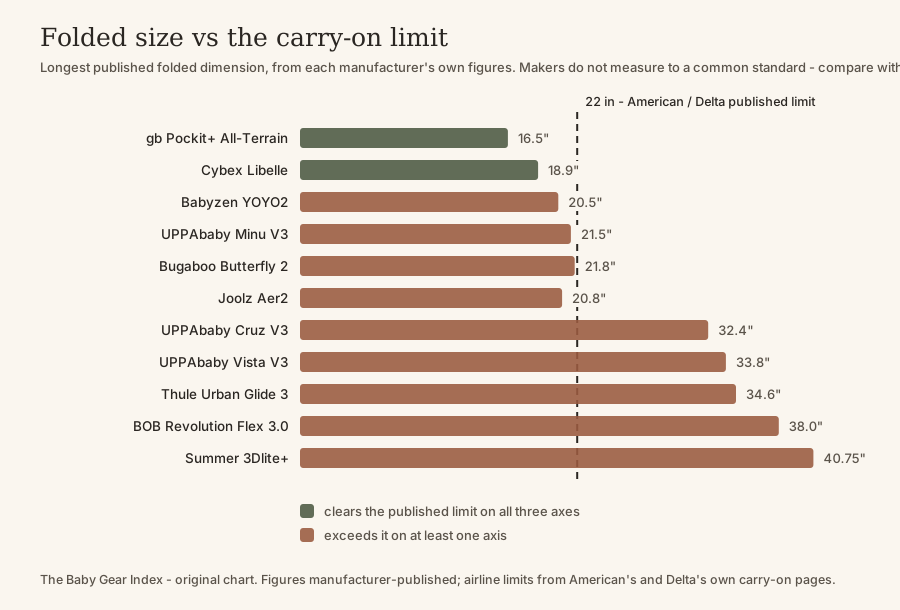
Every figure below comes from the manufacturer's own site, spec sheet or manual, and where a maker does not publish a number we print that instead of borrowing one. The two smallest folds among strollers whose makers publish the figure are the gb Pockit+ All-Terrain at 7.9 x 13.4 x 16.5 in and the Cybex Libelle at 12.6 x 7.8 x 18.9 in - and on published numbers, those are also the only two in this set that clear both American's and Delta's published carry-on limits. The single most important thing on this page is not a number, though: it is that manufacturers do not measure folded size the same way. Some measure with the seat on, some with wheels off, some publish two different folds for the same stroller, and one contradicts its own axis labels on its own page. Compare within a row, not across rows, unless both makers state the same condition.
This page exists because the single most useful stroller specification is also the least trustworthy one.
Folded dimensions decide whether a stroller fits your trunk, your hallway, your building’s lift or an overhead bin. Every maker publishes them. Almost no two makers measure them the same way - and once you start reading spec sheets side by side, the inconsistencies are not subtle. One manufacturer publishes its folded size with the seat attached and never publishes a frame-only figure. Another publishes two different folds for the same stroller. A third contradicts its own axis labels between its spec table and its FAQ, on the same page. A fourth flips the axis order between two rows of its own comparison chart.
So this is not a ranking. It is a sourced reference table with the conditions attached, plus a methodology note explaining why the numbers resist comparison. Every figure comes from the manufacturer’s own site, spec sheet or manual. Where a maker does not publish something, we print that instead of quietly substituting a retailer’s number - and the list of things manufacturers decline to publish turns out to be one of the more revealing sections here.
If you want recommendations rather than raw data, the six stroller guides linked at the foot of this page do that job. This page is the underlying data.
The table: folded dimensions and weight
All figures in inches and pounds, in the axis order the manufacturer itself publishes. Read the methodology note below before comparing any two rows.
| Stroller | Folded (in) | Self-stands | One-hand fold | Weight (lb) | Weight basis stated? |
|---|---|---|---|---|---|
| UPPAbaby Vista V3 | 16.3 x 25.7 x 33.8 (with seat) | Yes | No - "one-step" | 27.6 | No |
| UPPAbaby Cruz V3 | 17 x 22.5 x 32.4 | Yes | No - "one-step" | 26.5 | No |
| UPPAbaby Ridge V2 | 19.5 x 25.6 x 36 | Yes | Yes | 30 | No |
| UPPAbaby Minu V3 | 10 x 18 x 21.5 | Yes | Yes - fold and unfold | 16.7 | No |
| UPPAbaby Minu Duo | 12.9 x 27.8 x 23.7 | Yes | Yes | 27.4 | No |
| UPPAbaby G-Luxe | 19.2 x 12 x 41.8 | Yes | No - "two-step" | 16.3 | No |
| UPPAbaby G-Link V2 (double) | 40 x 20 x 14.5 | Not claimed | No - "two-step" | 22.3 | No |
| Bugaboo Butterfly 2 | 17.6 x 9.6 x 21.8 | Not stated | Not stated - "one-second fold" | 16 | Yes - "fully assembled" |
| Bugaboo Fox 5 | Two-piece 35 x 20.9 x 13.4; one-piece 17.3 x 23.6 x 35.4 | Yes (one-piece fold) | Not stated | 26.9 with seat; 28.6 with bassinet | Yes - explicit |
| Babyzen / Stokke YOYO2 | 20.5 x 17.3 x 7.1 | Not stated | Not stated | 13.6-14.5 | No - range unexplained |
| Cybex Libelle | 12.6 x 7.8 x 18.9 | Yes | No | 13.7 | No |
| gb Pockit+ All-Terrain | 7.9 x 13.4 x 16.5 | Yes (2-step fold) | No - two steps | not published by the maker | n/a |
| Joolz Aer2 | 17.3 x 20.8 x 9.2 | Not stated | Yes | 14.3 | No |
| Thule Urban Glide 3 | 34.6 x 22.8 x 12.2 | Yes | Yes | 26.2 | No |
| BOB Gear Revolution Flex 3.0 | Wheels on 38 x 25 x 16; wheels off 35 x 20 x 10 | Not stated | No - "2-step fold" | 28.5 | Partly - basis given for dimensions, not weight |
| Guava Roam | 29 x 15 x 17 | Not stated | Not stated | 28.5 | No |
| Baby Jogger City Mini GT2 | 31.5 x 24.5 x 10 (maker page is JavaScript-only; figure unverified at the maker) | Not stated | Yes - patented | 21.4 | No |
| Summer 3Dlite+ | 40.75 x 8.3 x 10.25 (retailer-sourced; no maker page located) | Not stated | No | 14 | No |
Sources: manufacturer product pages, spec sheets and comparison PDFs fetched 2026-07-28, except the two rows marked in the table. Figures are printed in the axis order each maker publishes, which is not consistent between makers - see the methodology note.
Open dimensions, limits and car seat compatibility
| Stroller | Unfolded (in) | Max child | Seat / sitting height | Car seat adapters |
|---|---|---|---|---|
| UPPAbaby Vista V3 | 36.5 x 25.7 x 39.5 | 50 lb (up to 3 children) | not published | Aria and Mesa attach directly; Chicco, Maxi-Cosi, Nuna, Cybex via adapter |
| UPPAbaby Cruz V3 | 37.5 x 22.5 x 41.8 | 50 lb | not published | Aria and Mesa direct; Maxi-Cosi, Nuna, Cybex |
| UPPAbaby Ridge V2 | 46.3 x 25.6 x 43 | 55 lb | not published | Aria, Mesa; Maxi-Cosi, Nuna, Cybex |
| UPPAbaby Minu V3 | 34.5 x 18 x 41 | 50 lb | not published | Aria, Mesa |
| UPPAbaby Minu Duo | 37.2 x 27.8 x 40.5 | 50 lb | not published | Aria, Mesa (one side only) |
| UPPAbaby G-Luxe | 28.8 x 18.8 x 43 | 55 lb, from 3 months | not published | None listed |
| UPPAbaby G-Link V2 | 27.5 x 28.5 x 42 | 55 lb per seat, from 3 months | not published | None listed |
| Bugaboo Butterfly 2 | 17.6 x 37.2 x 40.5 | not published in the set we read | Sitting space under canopy 26.8; seat 11.8 x 9.4; handlebar 40.3 | not published in the set we read |
| Bugaboo Fox 5 | 36.6 x 23.6 x 41.3 | 50 lb / about 4 years | Seat 15.4 wide x 19.7 long, extendable by 3.9 | not published in the set we read |
| Cybex Libelle | 28.7 x 20.5 x 40.9 | 55 lb, 6 months to about 4 years | not published | Adapters included in the box; all Cybex infant seats plus Nuna Pipa, Pipa Lite, Maxi-Cosi Mico Luxe |
| gb Pockit+ All-Terrain | not published by the maker | 55 lb, 6 months to about 5 years | not published | Stated as interchangeable with Cybex car seats; adapter inclusion not stated |
| Thule Urban Glide 3 | not in the spec table - drawings only | Max child 49 lb; max stroller capacity 75 lb | Sitting height 20; door pass-through 27.2 | Sold separately - Maxi-Cosi adapter, universal/Chicco adapter, bassinet |
| BOB Revolution Flex 3.0 | Overall width 24.5; handlebar 43 (9 positions) | 75 lb | Interior seat width 14.5 | Sold separately - BOB, Britax, Chicco, Cybex, Graco, Maxi-Cosi, Nuna, Peg Perego |
| Guava Roam | 39 x 25 x 43 | not published in the set we read | not published | not published in the set we read |
| Baby Jogger City Mini GT2 | not published in a retrievable form | 65 lb | Seat to canopy 26; seat width 14 | not published in a retrievable form |
What manufacturers decline to publish
These absences are findings, not gaps in our research. We looked; the numbers are not there.
- gb publishes the Pockit+ All-Terrain’s folded size, which is its entire marketing proposition, but publishes no stroller weight, no open dimensions, no maximum child height and no compliance statement on its US product page.
- Thule publishes folded dimensions for the Urban Glide 3 but not unfolded ones - only unlabelled dimension drawings.
- Baby Jogger serves its City Mini GT2 specifications from a JavaScript-only help centre that returns nothing to a plain request, so the maker’s own specs are effectively not citable.
- Summer Infant no longer exists as an independent manufacturer site; the brand now sits under Kids2 as Summer by Ingenuity, and we could not locate a Kids2-hosted 3Dlite+ spec page at all. Every figure in circulation is retailer-sourced.
- No maker in this set publishes a seat-back height. The nearest published proxies are Thule’s sitting height of 20 in, Baby Jogger’s seat-to-canopy of 26 in and Bugaboo’s sitting space under canopy of 26.8 in - three different measurements with three different names. There is no comparable tall-child longevity column available from manufacturer data, which is itself worth knowing if you are shopping for one.
- No maker in this set publishes a compliance statement on its consumer product page, with one partial exception: UPPAbaby’s 2026 comparison PDF carries a Baby Safety Alliance Verified row. Thule states only the unlabelled phrase that it meets safety standards, without naming a standard.
Why folded dimensions are not comparable
This is the part worth citing. Every observation below was made directly in manufacturer-published data during this research.
- Wheels on or off is rarely stated, and it changes everything. BOB is the only maker here that publishes both states - 38 x 25 x 16 in with wheels on, 35 x 20 x 10 in with them off. That is roughly a 65% reduction in folded volume from the same stroller. Everyone else publishes a single number without saying which condition it represents.
- Seat on or off is rarely stated either. UPPAbaby explicitly labels its column folded with seat, which is more transparency than anyone else offers - and it means the Vista V3’s published figure is the larger of two possible answers, with no frame-only figure published.
- Some strollers have two folds and no single number is correct. Bugaboo publishes both a two-piece compact fold and a one-piece self-standing fold for the Fox 5, with completely different dimensions.
- A maker can contradict itself on one page. The Cybex Libelle’s spec table gives folded dimensions as length 12.6, width 7.8, height 18.9 in. Two FAQ answers on the same page give the identical numbers in centimetres with the axis labels swapped between them.
- Axis order is not standardised, even within a brand. Bugaboo’s Butterfly 2 figures put width first in both the folded and unfolded triples, while Thule and UPPAbaby use length, width, height.
- Orientation convention can flip inside a single table. In UPPAbaby’s 2026 comparison PDF, the Vista V3 folded figure leads with the short axis while the G-Link V2 leads with the long axis - same column, same document. Sorting that column compares incompatible quantities.
- Weight basis is almost never disclosed. Bugaboo states it explicitly; Babyzen publishes an unexplained range; everyone else publishes a bare number. BOB mixes bases within one sheet, giving dimensions wheels-off and weight with no stated basis at all.
- Max child weight and max capacity get conflated. Thule publishes both, 49 lb and 75 lb, on the same table. Retail listings routinely quote the larger figure.
- Third parties disagree with makers and with each other, as the three conflicting Urban Glide 3 figures show.
- Self-standing and one-hand fold are marketing terms. UPPAbaby alone distinguishes one-step, one-handed and two-step folds across its own range - three different behaviours that a yes/no column flattens into one.
Our rule for this table: publish the maker’s number verbatim, publish the condition the maker states or say that no condition is stated, and never silently normalise. Compare within a row, not across rows, unless both makers state the same condition.
Overhead bin arithmetic
American and Delta both publish a carry-on maximum of 22 x 14 x 9 in including handles and wheels; Delta adds a combined cap of 45 linear inches. Applying those published limits to each maker’s own published folded figures gives the following. This is arithmetic on published numbers, not a test.
| Stroller | Folded (in) | Sum vs Delta's 45 in cap | Within 22 x 14 x 9? | On published figures |
|---|---|---|---|---|
| Cybex Libelle | 12.6 x 7.8 x 18.9 | 39.3 - passes | Yes on all three axes | Clears both airlines' published limits |
| gb Pockit+ All-Terrain | 7.9 x 13.4 x 16.5 | 37.8 - passes | Yes on all three axes | Clears both airlines' published limits |
| Babyzen YOYO2 | 20.5 x 17.3 x 7.1 | 44.9 - passes | No - 17.3 exceeds the 14 in limit | Fails one axis |
| Bugaboo Butterfly 2 | 17.6 x 9.6 x 21.8 | 49.0 - fails | No - 17.6 and 9.6 both exceed | Fails, despite the IATA-compatible claim |
| Joolz Aer2 | 17.3 x 20.8 x 9.2 | 47.3 - fails | No - 17.3 and 9.2 both exceed | Fails, despite the IATA-compliant claim |
| UPPAbaby Minu V3 | 10 x 18 x 21.5 | 49.5 - fails | No - 18 and 10 both exceed | Fails |
Limits from American Airlines' and Delta's own published carry-on pages, fetched 2026-07-28. United, Southwest, JetBlue and Alaska are omitted because their baggage pages would not render for us and we will not publish airline limits we have not read. Gate agents apply judgement; this is a paper check, not a guarantee.
What this table does not cover
Stated openly, because a reference asset that hides its scope is not a reference asset. This pass covers single strollers only. The entire double and twin category is absent - the Vista V3 in its double configuration, the City Mini GT2 Double, the Bugaboo Donkey 5, the Joovy Scooter X2, Graco’s DuoGlider and Modes Duo, and the Thule Urban Glide 3 Double. Also absent: Colugo, Chicco’s Bravo and Goody, the Thule Spring, the Nuna MIXX, the BOB Wayfinder, the Baby Jogger Summit X3, the Graco FastAction Jogger, the Kolcraft Cloud Plus and the Maclaren range. Zoe strollers are deliberately excluded: we found no CPSC recall, but a reported stability issue could be neither verified nor refuted from published sources, and we do not table claims we cannot source in either direction.
If you maintain a stroller brand and we have printed “not published by the maker” against a number you do in fact publish, we would genuinely like to correct it - the contact page is the fastest route.
The standing note: we analyze published specifications, certifications, and manufacturer documentation, and we compare head-to-head. We do not test products ourselves, and every figure here is traceable to the manufacturer, the Code of Federal Regulations, the CPSC or an airline’s own published policy.
Buyer's checklist: how to choose
- Read the condition, not just the number. BOB is the only maker in this set that publishes both states for the same stroller: wheels on, 38 x 25 x 16 in; wheels off, 35 x 20 x 10 in. That is roughly a 65% reduction in folded volume from the identical product. Every other maker here publishes one figure and does not say which condition it represents.
- Check whether the seat is included. UPPAbaby labels its column folded with seat, which is commendably explicit - and it means the published Vista V3 figure is the larger case. UPPAbaby publishes no frame-only folded figure even though the Vista folds without the seat.
- Some strollers have two folds and neither number is wrong. Bugaboo publishes a two-piece compact fold of 35 x 20.9 x 13.4 in for the Fox 5 and a one-piece self-standing fold of 17.3 x 23.6 x 35.4 in. Any single-column table silently picks one of them.
- Do not assume the axis order is L x W x H. Bugaboo publishes the Butterfly 2 folded as 17.6 x 9.6 x 21.8 and unfolded as 17.6 x 37.2 x 40.5 - the 17.6 is the width in both, so the published triple is really width, length, height. Thule and UPPAbaby do use length, width, height. Within UPPAbaby's own 2026 comparison PDF, the Vista V3 row leads with the short axis and the G-Link V2 row leads with the long axis, in the same column.
- Weight basis is almost never stated. Bugaboo is the exception, publishing 26.9 lb with the seat and 28.6 lb with the bassinet for the Fox 5 and 16 lb fully assembled for the Butterfly 2. Babyzen publishes a range - 13.6 to 14.5 lb - without explaining what varies. And BOB's sheet mixes bases within itself: folded dimensions given wheels-off, weight given with no stated basis.
- Max child weight and total capacity are different numbers, and get conflated constantly. Thule's own spec table for the Urban Glide 3 lists a maximum child weight of 49 lb and a maximum stroller weight capacity of 75 lb. Retail listings routinely quote the 75.
- Self-standing and one-hand fold are marketing terms, not measured properties. UPPAbaby distinguishes one-step, one-handed and two-step folds across its own line - three different things that a yes/no checkbox flattens. Bugaboo advertises a one-second fold and never states whether it is one-handed.
- Third parties disagree with makers and with each other. For the Thule Urban Glide 3 folded size, Thule says 34.6 x 22.8 x 12.2, a review site reports 37 x 26.6 x 15.2, and a retailer lists 12.25 x 23 x 34.75. We print the maker's figure and note the conflict.
Frequently asked questions
Which stroller has the smallest fold?
Among strollers whose makers actually publish the figure, the gb Pockit+ All-Terrain at 7.9 x 13.4 x 16.5 in (20 x 34 x 42 cm) is the smallest by volume, followed by the Cybex Libelle at 12.6 x 7.8 x 18.9 in. Two caveats matter. First, gb publishes the folded size - it is the product's entire proposition - but publishes no stroller weight, no open dimensions, no maximum child height and no compliance statement on its US page, so the widely quoted 12.3 lb is retailer-sourced rather than from the maker. Second, the Pockit+ uses a two-step fold rather than a one-hand one, which is the trade-off for the size. If you want the smallest fold with a complete published spec sheet behind it, the Libelle is the better-documented product.
Will my stroller fit in an airplane overhead bin?
Do the arithmetic on published numbers rather than trusting the label. American Airlines publishes a carry-on maximum of 22 x 14 x 9 in including handles and wheels, and requires it to fit the airport sizer. Delta publishes the same 22 x 14 x 9 in and adds a combined limit of 45 linear inches, and states that the FAA mandates all carry-on items fit under a seat or in an enclosed storage compartment. Against those published limits: the Cybex Libelle (12.6 x 7.8 x 18.9, sum 39.3) and the gb Pockit+ All-Terrain (7.9 x 13.4 x 16.5, sum 37.8) clear both. The Babyzen YOYO2 fails the 14-inch limit on one axis. The Bugaboo Butterfly 2, the Joolz Aer2 and the UPPAbaby Minu V3 each fail on the linear-inch total and on at least one axis. This is arithmetic on published figures, not something we have carried through an airport, and gate agents apply judgement - but it is a much better starting point than the marketing. We could not verify United's, Southwest's, JetBlue's or Alaska's published limits this pass, because those pages would not render, so we deliberately do not quote them.
Is airline approved a meaningful claim?
In this set, no - and the numbers show why. Bugaboo claims the Butterfly 2 is IATA-compatible, meaning its folded dimensions meet the requirements for carry-on luggage, and that it fits in overhead compartments when flying. But its own published folded size exceeds American's and Delta's published limits in two of three dimensions. IATA is an airline trade body whose cabin-bag guideline is not what US carriers enforce. Joolz markets the Aer2 similarly. Cybex claims hand-luggage compatibility for 99% of airlines - an unsourced statistic, even though the Libelle is one of only two here that actually clears the published limits. gb claims airplane hand-luggage compliance with no airline, dimension or source named. The most honest of the group is Babyzen, whose FAQ says the folded size is equal to or less than most airlines' cabin luggage allowance and adds that standards vary by airline and you should check with yours. Not one maker in this set names a specific airline or quotes a specific bin dimension. Bugaboo does at least add the hedge that you should check with your airline before travelling.
Do I have to pay to check a stroller at the gate?
Every major US carrier we could verify publishes a free allowance, though we want to be precise about what that is and is not. American states that each ticketed customer is allowed one stroller and one car seat to be checked free of charge when travelling with a child, that non-collapsible strollers and stroller wagons without built-in child safety straps must be checked at the ticket counter while all other strollers can go at the gate, and that strollers and car seats do not count as your carry-on or personal item. Delta states that children's strollers and child safety seats are not counted as part of the standard baggage and can be checked for free, at curbside, the ticket counter or the gate. What we could not verify is a US Department of Transportation regulation mandating free stroller gate-checking - the relevant federal page would not load for us, and we are not going to assert a rule we cannot cite. The honest framing is that free stroller checking is published airline policy at every major US carrier we checked, not a federal mandate we were able to confirm.
What is the federal safety standard for strollers?
16 CFR Part 1227, the Safety Standard for Carriages and Strollers. Section 1227.2 states, verbatim, that each carriage and stroller shall comply with all applicable provisions of ASTM F833-21, approved June 15, 2021 - a version noted in the CFR at 86 FR 64349, November 18, 2021. The standard was mandated by section 104(b)(1) of the CPSIA and first issued at 79 FR 13208 in 2014. Compliance is keyed to the date of manufacture: strollers made after February 15, 2022 must meet ASTM F833-21; after November 5, 2019, F833-19; after October 2, 2016, F833-15; and after September 10, 2015, F833-13b with CPSC modifications. In plain terms it covers sharp points and edges, small parts, lead in surface coatings, latching mechanisms, openings, scissoring and pinching, exposed coil springs, labelling, seat recline measurement, cord and strap length, and tray coverings - plus performance requirements for the parking brake, static load, stability, the restraining system, occupant retention, impact, passive containment, wheel and swivel detachment, and head entrapment with a car seat mounted. Manufacturers must issue a Children's Product Certificate citing 16 CFR part 1227, apply permanent labelling under 16 CFR 1130.4, and include a consumer registration form. The important consequence: because compliance is mandatory and universal, it is a floor rather than a feature. It does not distinguish one stroller here from another.
Is JPMA certification still a thing?
Not under that name. JPMA rebranded to the Baby Safety Alliance in June 2025, and the JPMA Certified Seal is now the Baby Safety Alliance Verified Seal - the organisation says so in its own words, describing the seal as formerly the JPMA Certified Seal. The programme itself is unchanged in substance: it is explicitly voluntary, based on adherence to ASTM standards, federal and state law and some retailer requirements, with each product sample-tested at an independent CPSC-accredited laboratory and retested annually. It now covers more than 3,200 products across 30-plus categories in the US and Canada, with child restraint systems added in 2025. We can see it in live use: UPPAbaby's own 2026 stroller comparison PDF carries a Baby Safety Alliance Verified row. If a page you are reading still says JPMA Certified in 2026, that page has not been updated.
Which of these strollers have been recalled?
Three items in or adjacent to this set carry recalls recent enough to disclose. The Stokke YOYO3 was recalled in November 2024 (recall 25-044, about 2,890 units) because the parking brake can disengage, posing an injury hazard - serial numbers beginning 142AA followed by numbers below 0062239, sold September to October 2024, remedy a full refund, no injuries reported. The Guava Family Roam was recalled in November 2024 (recall 25-032, about 8,500 units) because the brakes can fail to engage or unexpectedly disengage, with 67 reports of the brake lock disengaging and 152 reports of the brake pedal not engaging, no injuries - scope is first-generation units manufactured July 2020 to December 2021, and the remedy is a free repair kit. And in June 2026, Joolz recalled about 3,840 Aer2 car seat adapters (recall 26-568) because they can fail to attach properly and allow the car seat to fall; the Aer2 stroller itself is not recalled, only the adapter accessory, and the remedy is a full refund on return. Older brand-level recalls worth knowing if you buy secondhand include the UPPAbaby Ridge jogging stroller in 2022 for a fingertip amputation hazard, Mockingbird's 2023 fall-hazard recall, Bugaboo's 2024 Dragonfly recall and Thule's 2020 recall. For everything else in this table we found no CPSC stroller recall since 2020 - with the caveat that our search matched on product-name strings, so always check your exact model at cpsc.gov/Recalls before buying.
The staples, if you want to add them now
Unbranded basics where the brand genuinely does not matter much — the things this list says to get, without a guide attached because none is needed. Links go to Amazon search results so you can compare what is actually in stock.
- BOB Gear Revolution Flex 3.0
- Baby Jogger City Mini GT2
- Babyzen YOYO2
- Bugaboo Butterfly 2
- Bugaboo Fox 5
- Cybex Libelle
- Guava Roam
- Joolz Aer2
- Summer 3Dlite+
- Thule Urban Glide 3
- UPPAbaby Cruz V3
- UPPAbaby G-Link V2
- UPPAbaby G-Luxe
- UPPAbaby Minu Duo
- UPPAbaby Minu V3
- UPPAbaby Ridge V2
- UPPAbaby Vista V3
- gb Pockit+ All-Terrain
Sources, and when we checked
Every product on this page was verified as currently sold by its manufacturer and checked against the CPSC recall database on 2026-07-28. Recalls are issued continuously — check before you buy.
- CPSC recall database — checked per product, date above
- CPSC SaferProducts.gov recall API
We do not test products. Specifications come from the manufacturer's own published documentation; safety facts are cited to the primary source above rather than to secondary reporting.